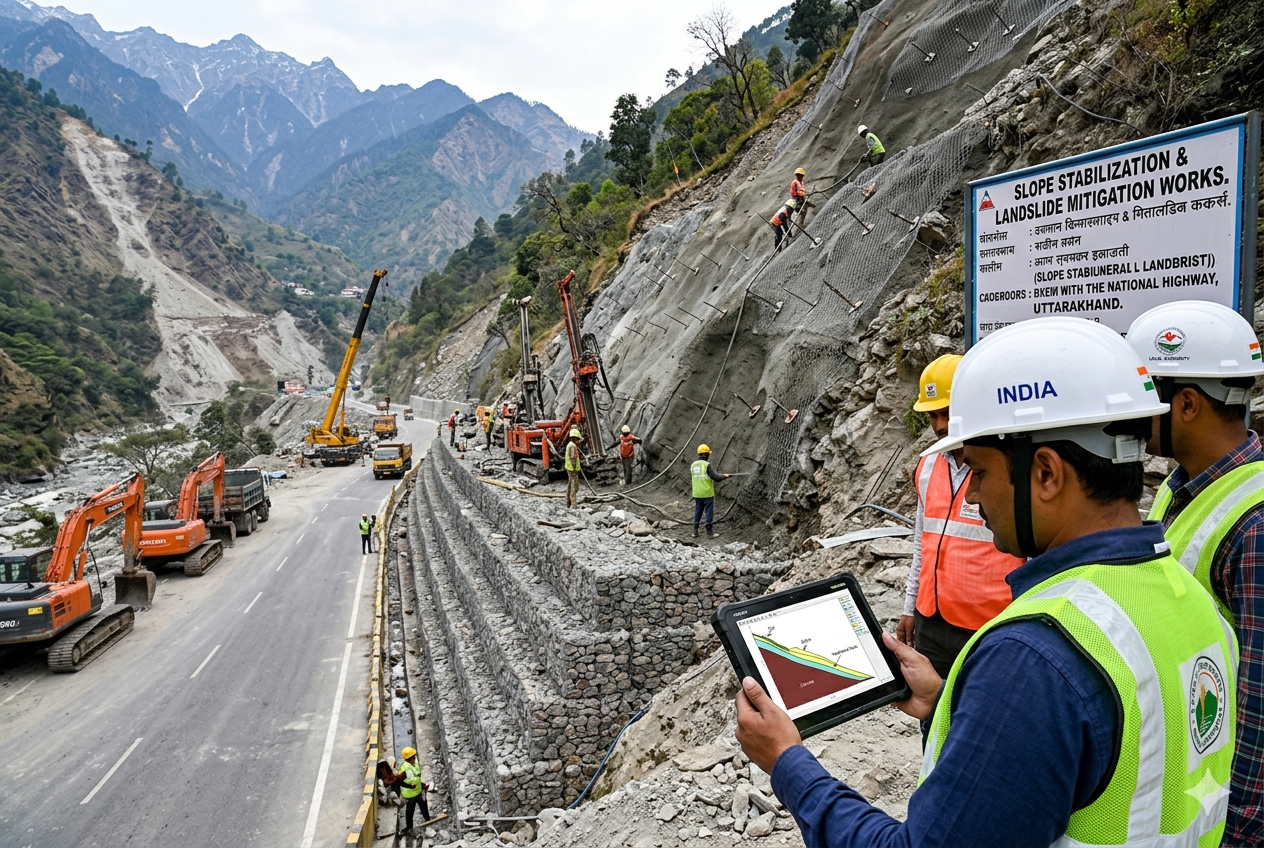
Comprehensive Guide to Slope Stability Analysis: Methods, Software, and Best Practices for Infrastructure Projects
Slope stability analysis is one of the most critical aspects of geotechnical engineering, playing a vital role in ensuring the safety and longevity of infrastructure projects. From national highways and railway tunnels to hydroelectric projects and urban development, understanding slope behavior is essential for preventing landslides, protecting lives, and minimizing economic losses.
In this comprehensive guide, we''ll explore the fundamental concepts, advanced methodologies, software applications, and industry best practices for slope stability analysis. Whether you''re a civil engineer, geologist, or project manager, this article will provide valuable insights into this crucial engineering discipline.
What is Slope Stability Analysis?
Slope stability analysis is the evaluation of the stability of soil or rock slopes under various conditions. It involves assessing the factor of safety (FOS) against potential failure mechanisms such as landslides, rockfalls, or slope collapse. The analysis considers geological conditions, groundwater levels, seismic activity, and external loads to determine whether a slope is safe or requires reinforcement.
At RBEG Consultancy LLP, we specialize in comprehensive slope stability assessments using advanced numerical modeling and field investigation techniques. Our expert team, led by Prof. Dr. B. C. Mandal (Senior Geologist & Geotechnical Expert with 33+ years of experience), delivers precise and reliable analysis for infrastructure projects across India.
Why Slope Stability Analysis Matters
The importance of proper slope stability analysis cannot be overstated. Here are key reasons why it''s essential for infrastructure development:
1. Safety and Risk Mitigation
Slope failures can result in catastrophic consequences, including loss of life, property damage, and environmental degradation. According to the National Disaster Management Authority (NDMA), landslides cause significant damage in Himalayan regions and Western Ghats annually. Proper analysis helps identify potential failure zones and implement preventive measures.
2. Economic Considerations
The cost of slope failure remediation often exceeds the initial investment in proper analysis and design. A comprehensive slope stability study can save millions in repair costs and project delays. For example, the Silkyara Tunnel investigation conducted by RBEG helped identify collapse causes and effective remedial measures, preventing further damage.
3. Regulatory Compliance
Infrastructure projects require mandatory geotechnical investigations as per guidelines from bodies like National Highways & Infrastructure Development Corporation Ltd (NHIDCL), Indian Railways, and Central Water Commission. Our DPR preparation services ensure full compliance with all regulatory requirements.
4. Long-term Infrastructure Sustainability
Properly analyzed and protected slopes ensure the longevity of roads, tunnels, dams, and buildings. This is particularly crucial for critical infrastructure like railway tunnels and hydroelectric projects where failure can have far-reaching consequences.
Types of Slope Failures
Understanding failure mechanisms is fundamental to effective slope stability analysis. Common types include:
1. Planar Failure
Occurs along a single, well-defined discontinuity surface. Common in rock slopes with persistent joints or bedding planes. Kinematic analysis is essential for identifying planar failure potential.
2. Wedge Failure
Results from the intersection of two or more discontinuities forming a wedge that slides out of the slope face. This is one of the most common failure mechanisms in rock slopes.
3. Circular/Rotational Failure
Typically occurs in soil slopes or heavily fractured rock masses where failure surface approximates a circular arc. This is common in homogeneous materials like clays and weathered rock.
4. Toppling Failure
Involves forward rotation of rock columns or blocks about a pivot point. Common in steeply dipping discontinuities.
5. Rockfall
Individual rock fragments detach and fall freely, bounce, or roll down the slope. Requires specialized analysis and protection measures like rock bolts and wire mesh.
Slope Stability Analysis Methods
At RBEG Consultancy, we employ multiple analytical approaches to ensure comprehensive assessment:
1. Limit Equilibrium Method (LEM)
The most widely used approach, LEM calculates the factor of safety by comparing resisting forces to driving forces. Methods include:
- Bishop''s Simplified Method - Suitable for circular failure surfaces
- Janbu''s Method - Handles non-circular surfaces
- Spencer''s Method - Considers both force and moment equilibrium
- Morgenstern-Price Method - Rigorous approach for complex geometries
2. Finite Element Method (FEM)
Advanced numerical modeling that provides detailed stress-strain analysis. Our team uses Phase2/RS2 software for sophisticated FEM analysis, offering advantages like:
- Stress concentration identification
- Progressive failure simulation
- Soil-structure interaction modeling
- Groundwater flow coupling
3. Kinematic Analysis
Essential for rock slope stability, kinematic analysis evaluates the potential for planar, wedge, and toppling failures based on discontinuity orientations. Using Dips software, we perform stereographic projection analysis to identify critical joint sets.
4. Probabilistic Analysis
Incorporates uncertainty in input parameters to provide probability of failure estimates, particularly useful for complex geological conditions.
Advanced Software for Slope Analysis
RBEG Consultancy utilizes industry-leading software tools for precise and reliable analysis:
1. Phase2 / RS2 (Rocscience)
Advanced 2D finite element program for soil and rock slope stability analysis. Features include:
- Elastic-plastic and strength reduction analysis
- Groundwater seepage modeling
- Support structure interaction
- Dynamic analysis for seismic loading
2. Slide (Rocscience)
Comprehensive limit equilibrium analysis software supporting multiple methods and complex geometries.
3. Dips (Rocscience)
Interactive stereographic projection software for kinematic analysis and structural geology interpretation.
4. RocLab
Rock mass classification and strength parameter determination based on Hoek-Brown criterion.
5. FLAC/SLOPE
Finite difference software for advanced geotechnical analysis, particularly useful for large deformation problems.
Our team at RBEG Consultancy has extensive expertise in these software packages, ensuring accurate and reliable results for your projects.
Site Investigation Techniques
Accurate slope stability analysis begins with comprehensive site investigation. Our approach includes:
1. Geological Mapping
Detailed surface mapping to identify rock types, structural features, and potential failure zones. Our geologists conduct systematic discontinuity surveys measuring orientation, spacing, persistence, and roughness.
2. Geotechnical Drilling
Strategic borehole drilling for subsurface investigation, including:
- Standard Penetration Test (SPT) for soil properties
- Core drilling for rock mass characterization
- In-situ permeability testing (Lugeon tests)
- Groundwater level monitoring
3. Geophysical Investigations
Non-invasive techniques for rapid subsurface characterization:
- Seismic Refraction Test (SRT) - Determines layer depths and rock profiles
- Electrical Resistivity Tomography (ERT) - Identifies groundwater zones and weak zones
- Cross-hole Seismic Testing - Provides shear wave velocity profiles
4. Laboratory Testing
Comprehensive testing of soil and rock samples:
- Soil Tests: Grain size, Atterberg limits, triaxial compression, direct shear
- Rock Tests: Uniaxial Compressive Strength (UCS), Point Load Index, Brazilian Tensile Strength
Slope Protection and Mitigation Measures
Based on our analysis, we design appropriate protection measures tailored to site-specific conditions:
1. Rock Bolts and Anchors
Active reinforcement that stabilizes potential failure blocks by tensioning against the stable rock mass. Design considerations include bolt length, spacing, and capacity.
2. Shotcrete
Sprayed concrete applied to slope surfaces to prevent weathering and provide immediate support. Can be reinforced with wire mesh or steel fibers for enhanced strength.
3. Retaining Structures
Various options depending on site conditions:
- Gabion walls - Flexible, permeable structures for moderate slopes
- Reinforced earth walls - Cost-effective for highway embankments
- Concrete retaining walls - For high loads and space constraints
4. Drainage Systems
Critical for slope stability, including:
- Surface drains and catchments
- Subsurface drainage (horizontal drains, weep holes)
- Geocomposite drains
5. Bio-engineering Solutions
Environmentally friendly approaches:
- Hydroseeding for erosion control
- Vegetation and root reinforcement
- Jute matting and coir blankets
Case Studies from RBEG Consultancy
Our expertise in slope stability analysis is demonstrated through successful project deliveries across India:
Project 1: NH-09 Landslide Zone Treatment, Uttarakhand
Client: HMBS Textiles Private Limited
Scope: Treatment of landslide zones from km 62.860 to km 152.750 on NH-09
Deliverable: Comprehensive geological mapping report focusing on rock mass properties of the slope area at 28 locations
Project 2: Silkyara Tunnel Investigation, Uttarkashi
Client: Navayuga Engineering Company Ltd
Scope: Investigation to explore possible causes of collapse and effective remedies
Outcome: Provided critical recommendations for tunnel recovery and future prevention measures
Project 3: Dubai Slope Stability Analysis, UAE
Client: Kalpataru Power Transmission Limited
Scope: Design, supply, installation of 132kv OHL & cable works between Hatta PSHPP and Warsan substation
Deliverable: Comprehensive slope stability calculation through finite element method
Project 4: NH-717A Slope Protection, Sikkim
Client: Innovative Infra and Geo Solutions
Scope: Geological mapping for upgradation of existing road to 2-lane
Deliverable: Detailed slope stability analysis and protection design
Best Practices for Engineers
Based on our extensive experience, here are key best practices for effective slope stability analysis:
1. Comprehensive Site Characterization
Invest adequate time and resources for field investigations. Incomplete data leads to inaccurate analysis and potentially unsafe designs.
2. Use Multiple Analysis Methods
Cross-validate results using both limit equilibrium and finite element methods. Each approach provides unique insights that complement each other.
3. Consider Groundwater Effects
Groundwater is a primary cause of slope instability. Always incorporate seepage analysis and consider seasonal water level fluctuations.
4. Account for Seismic Loading
In seismically active regions like the Himalayas, dynamic analysis is essential for accurate stability assessment.
5. Quality Assurance in Laboratory Testing
Ensure proper sample handling, storage, and testing procedures to obtain reliable soil and rock parameters.
6. Continuous Monitoring
Implement instrumentation and monitoring systems during and after construction to verify design assumptions and detect early warning signs.
Conclusion
Slope stability analysis is a complex but essential discipline in geotechnical engineering. With climate change increasing the frequency of extreme weather events and infrastructure development expanding into challenging terrains, the importance of proper slope assessment has never been greater.
At RBEG Consultancy LLP, we combine decades of field experience with advanced analytical tools to deliver reliable, cost-effective solutions for your slope stability challenges. Our multidisciplinary team of geologists, geotechnical engineers, and structural designers works collaboratively to ensure your project''s safety and success.
Whether you''re planning a national highway, railway tunnel, hydroelectric project, or urban development, our expertise in slope stability analysis, landslide mitigation, and DPR preparation can help you navigate the geological challenges and deliver a safe, sustainable infrastructure.
Contact us today to discuss your project requirements and learn how RBEG Consultancy can support your next infrastructure venture.
? Phone: 0091 8583874818, 0091 9330546639
? Email: info@rbegconsultancy.com, bidarin20022002@gmail.com
? Address: 1018, Bishalaxmeetala, Near Play Ground, Baruipur, Kolkata - 700144, WB